Foot Pain from Pickleball & HYROX? A Podiatrist in KL Explains What's Going On
If you've picked up a pickleball paddle in the last year or started training for your first HYROX race; you're not alone. These two sports are among the fastest-growing fitness trends in Malaysia right now. Pickleball courts are popping up across the Klang Valley from Subang and Shah Alam to Setia Alam and Sentul, while HYROX training communities are expanding rapidly at gyms like Fitness First, Celebrity Fitness, and dedicated facilities across KL and Selangor, with Malaysia's inaugural HYROX event confirmed for Kuala Lumpur in December 2026.
But here's what most new players and athletes don't expect: both sports are surprisingly tough on your feet, ankles, and lower limbs. At KL Foot Specialist Podiatry, we're seeing a growing number of patients coming in with foot and ankle injuries linked directly to pickleball and HYROX training. This article explains why these sports stress your feet, what injuries are most common, and when it's time to see a podiatrist.
Reviewed by Patricia, Podiatrist - Australia-trained, 9+ years clinical experience
Key Takeaways
Pickleball's quick lateral movements and HYROX's combination of running with heavy functional exercises both place significant stress on your feet, ankles, and lower limbs.
The most common injuries include ankle sprains, plantar fasciitis, Achilles tendinopathy, shin splints, and stress fractures - many of which start as minor niggles that worsen when ignored.
Wearing the wrong shoes (especially running shoes for pickleball, or worn-out trainers for HYROX) is one of the biggest preventable risk factors.
A podiatrist can identify biomechanical issues like flat feet or overpronation and provide targeted treatment to keep you training.
You don't need to stop playing. You need to address the root cause so your feet can keep up with your ambitions.
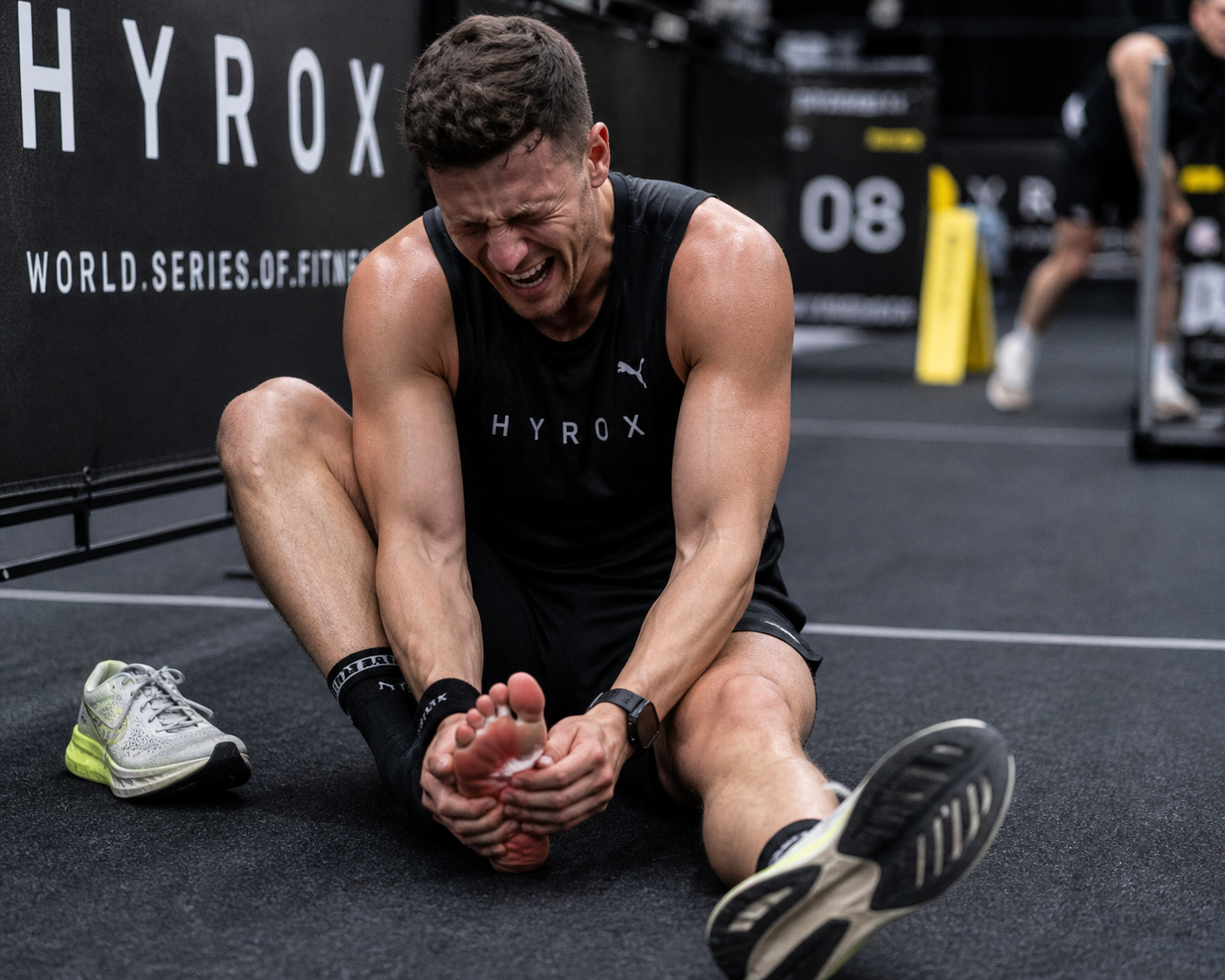
Why Pickleball Is Tougher on Your Feet Than You Think
Pickleball looks gentle. The court is smaller than a tennis court, the pace seems relaxed, and players of all ages and fitness levels can pick it up quickly. But the sport demands rapid lateral movements, sudden changes of direction, quick lunges to the net, and explosive pivots that place enormous stress on your ankles, arches, and forefeet.
The specific movements that cause trouble are the side-to-side shuffles (which load the outside of the ankle and the peroneal tendons), the forward lunges (which stretch the Achilles tendon and compress the forefoot), and the sudden stops and starts (which jar the plantar fascia with each deceleration). Unlike running, which is primarily a forward motion, pickleball asks your feet to move in every direction and that's where injuries happen.
What often gets overlooked is that many of these injuries start from the feet from structural issues like flat feet, poor footwear choices, or biomechanical imbalances that a podiatrist is specifically trained to identify and treat.
Why HYROX Training Puts Your Feet Through the Wringer
HYROX is a different beast entirely. The race format being eight 1 km runs, each followed by a functional workout station (sled push, sled pull, burpee broad jumps, rowing, farmer's carry, sandbag lunges, wall balls); creates a unique combination of repetitive running impact and heavy functional loading that few other sports demand.
For your feet and lower limbs, this means cumulative stress from multiple directions. The 8 km of total running loads the plantar fascia, Achilles tendon, and shin muscles with repetitive impact. The sled push and sled pull demand powerful toe-off and forefoot drive, stressing the metatarsals and the ball of the foot. Sandbag lunges under fatigue challenge ankle stability and can aggravate existing biomechanical weaknesses like overpronation. And farmer's carries increase the total load through every step, compressing the arches and heel.
The critical difference with HYROX is that these heavy functional exercises are performed while already fatigued from running. When your muscles are tired, your form breaks down and that's when your feet, ankles, and knees take the hit. Physiotherapy and sports medicine clinics across the region are already seeing a consistent pattern of runner's knee, Achilles tendinopathy, plantar fasciitis, lower back strain from sled work, and shin splints in HYROX athletes.
Common Foot and Ankle Injuries We See from Both Sports
While pickleball and HYROX stress the body in different ways, many of the resulting foot and ankle injuries overlap. Here are the conditions we most commonly treat at KL Foot Specialist in patients who play these sports.
Ankle sprains are the hallmark pickleball injury. The rapid lateral movements and sudden direction changes can cause the ankle to roll, stretching or tearing the ligaments on the outside of the ankle. Many players "walk it off" or rely on traditional remedies, but without proper rehabilitation, the ankle heals in a weakened state and becomes prone to repeated spraining - a condition called chronic ankle instability. HYROX athletes are also at risk, particularly during sandbag lunges and burpee broad jumps performed on fatigued legs.
Plantar fasciitis; that sharp, stabbing pain in the heel or arch, especially first thing in the morning is common in both sports. In pickleball, it develops from the repeated impact of lunging and pivoting on hard court surfaces. In HYROX, the cumulative 8 km of running combined with heavy sled work and lunges creates relentless stress on the plantar fascia. This is one of the most frequent conditions we treat at KL Foot Specialist, and it responds well to a combination of biomechanical assessment, custom orthotics, and shockwave therapy.
Achilles tendinopathy presents as pain and stiffness at the back of the heel or lower calf. HYROX athletes are especially vulnerable because of the high running volume combined with explosive push-off movements at the sled stations. Pickleball players develop it from repeated lunging and the sudden acceleration-deceleration pattern of the game. If you notice a persistent ache in the back of your heel that worsens with activity, don't ignore it. Achilles injuries that are caught early are far easier to manage than those left to become chronic.
Shin splints - pain along the front or inner edge of the shin bone are a classic overuse injury in HYROX training, particularly among athletes who ramp up their running volume too quickly. The repeated impact of 8 km of running, often on hard indoor surfaces, overloads the muscles and connective tissue along the tibia. This is frequently worsened by flat feet or overpronation, both of which a podiatrist can identify through a biomechanical assessment.
Stress fractures are the most serious injury on this list. They develop when repetitive loading exceeds the bone's ability to repair itself - tiny cracks that worsen with continued activity. The metatarsals (bones in the ball of the foot) and the heel bone are most commonly affected. Stress fractures are more common in HYROX athletes due to the sheer volume of impact, but they can also occur in dedicated pickleball players who play multiple sessions per week without adequate recovery.
The "Weekend Warrior" Problem in KL
Here's a pattern we see regularly at the clinic: someone discovers pickleball or joins a HYROX training group, gets hooked, and goes from zero to four or five sessions a week within a month. The enthusiasm is wonderful but the feet, ankles, and tendons haven't had time to adapt to the new demands.
This is the "weekend warrior" problem, and it's particularly common in KL's fitness community. Many players and athletes have sedentary desk jobs during the week and then push hard on evenings and weekends. The rapid jump in activity level without a gradual build-up is one of the most common causes of overuse injuries like plantar fasciitis, shin splints, and Achilles tendinopathy.
Add to this some KL-specific factors: training on hard indoor surfaces (concrete or tile under thin court flooring), Malaysia's heat and humidity causing excessive foot sweat inside shoes, and the common habit of wearing flat casual shoes or flip-flops outside of sport which offers zero support for feet that are already under stress from training.
Footwear Mistakes That Make Everything Worse
One of the most preventable risk factors we see is wearing the wrong shoes. Specifically:
Running shoes for pickleball is a common mistake. Running shoes are designed for forward motion; they have cushioning but minimal lateral support. Pickleball demands side-to-side movement, and running shoes increase your risk of ankle rolls and sprains. You need court shoes with lateral stability, a non-marking sole, and a supportive heel counter.
Worn-out trainers for HYROX is equally problematic. HYROX training requires shoes that can handle both running and functional exercises. Many athletes use the same pair of trainers for months past their effective lifespan, losing the cushioning and support that protects against plantar fasciitis and stress fractures. If you're training seriously, rotate between shoes and replace them regularly.
No sport-specific shoes at all is surprisingly common among casual pickleball players in KL who play in whatever trainers they happen to own. If you're playing more than once a week, investing in proper court shoes is one of the simplest things you can do to protect your feet.
When to See a Podiatrist - Not Just a Physio
Many athletes in KL experiencing foot pain go straight to a physiotherapist or an orthopaedic surgeon. Both play important roles, but here's what makes a podiatrist different: we specialise exclusively in the foot, ankle, and lower limb. We assess how your feet move and how that movement affects your entire kinetic chain from your arches up through your knees, hips, and lower back.
A biomechanical assessment can reveal issues like flat feet (which increase pronation and stress on the arch and shin), high arches (which reduce shock absorption and increase stress fracture risk), overpronation or supination patterns that affect ankle stability, and leg length differences that create asymmetric loading.
These are the root causes that keep injuries coming back, even after rest and rehabilitation. Addressing them often through custom orthotics tailored to your foot shape and sport is what breaks the cycle.
For active injuries, we also offer DolorClast® Shockwave Therapy for stubborn plantar fasciitis and Achilles tendinopathy, and DolorClast® High Power Laser Therapy for inflammation and tissue healing both non-invasive, no downtime, and designed to get you back to your sport faster.
How to Protect Your Feet If You Play Pickleball or Train HYROX
You don't need to stop playing. You need to be smart about how you prepare and recover. Here are practical steps that can make a real difference.
Build up gradually. If you're new to either sport, increase your sessions and intensity by no more than 10–15% per week. Your muscles adapt faster than your tendons, ligaments, and bones - give them time.
Warm up properly. Five to ten minutes of dynamic stretching like calf raises, ankle circles, light jogging before you play or train. This is especially important for the Achilles tendon and plantar fascia.
Invest in the right shoes. Court shoes for pickleball, cross-training shoes with good cushioning for HYROX. Replace them when they show signs of wear.
Stretch and recover. Foam rolling, calf stretches, and foot rolling (a frozen water bottle under the arch works well) after sessions. Don't skip recovery days.
Listen to your feet. A mild ache that goes away during warm-up is normal. Pain that persists during activity, worsens after, or appears every morning is your body telling you something needs attention.
Get a biomechanical check. If you're training regularly for pickleball or HYROX, a podiatric assessment before an injury occurs is the smartest investment you can make. It's far easier to prevent a problem than to fix one.
Still Playing Through the Pain? Let's Fix That.
If your feet or ankles are hurting during or after pickleball, or if HYROX training is leaving you limping the next day - that's not normal, and it's not something you have to accept.
At KL Foot Specialist Podiatry in Sri Petaling, we treat sport-related foot and ankle injuries every week. Whether it's an ankle sprain that won't settle, plantar fasciitis that keeps coming back, or Achilles pain that's holding you back from race day; we can help you find the root cause and get you back on court or on the starting line.
Not sure if what you're experiencing needs attention? WhatsApp us at +60126937216 - we'll help you figure it out.
Ready to take the first step? Book a consultation with KL Foot Specialist Podiatry in Sri Petaling, KL.
Visit us at 19-G, Jln Radin Bagus 5, Bandar Baru Sri Petaling, 57000 Kuala Lumpur. We're open Monday–Saturday 9 AM–6 PM.