Flat Feet in Malaysia: When Should You (or Your Child) See a Podiatrist?
You've probably heard it before, someone spots their child's footprint on a wet bathroom floor and worries. No arch. Just a flat impression from heel to toe. Or maybe your own feet have been aching for years and someone finally says, "Oh, you have flat feet." And you're left wondering: is this serious? Does it need fixing? And what does a podiatrist actually do about it?
The answer? It depends. Not all flat feet are the same and not all of them need treatment. Here's how to tell the difference.
Reviewed by Patricia Ting, Principal Podiatrist (MPodPrac), Australia-trained with clinical experience across Melbourne, Brisbane, and Singapore, KL Foot Specialist Podiatry, Sri Petaling, Kuala Lumpur.Last reviewed: June 2026.
Key Takeaways
Flat feet (kaki rata / tapak kaki rata) are extremely common, especially in Asian populations. Having them doesn't automatically mean something is wrong
Children's arches often develop naturally up to age 8–10; early flat feet in toddlers are usually normal
Flat feet in adults can cause pain in the heel, arch, knee, hip, or lower back if left unaddressed
The "wet footprint test" is a simple way to check your arch at home but only a podiatrist can assess whether your gait is affected
Custom orthotics address the root cause; generic insoles from pharmacies or online stores only provide temporary cushioning
What Are Flat Feet?
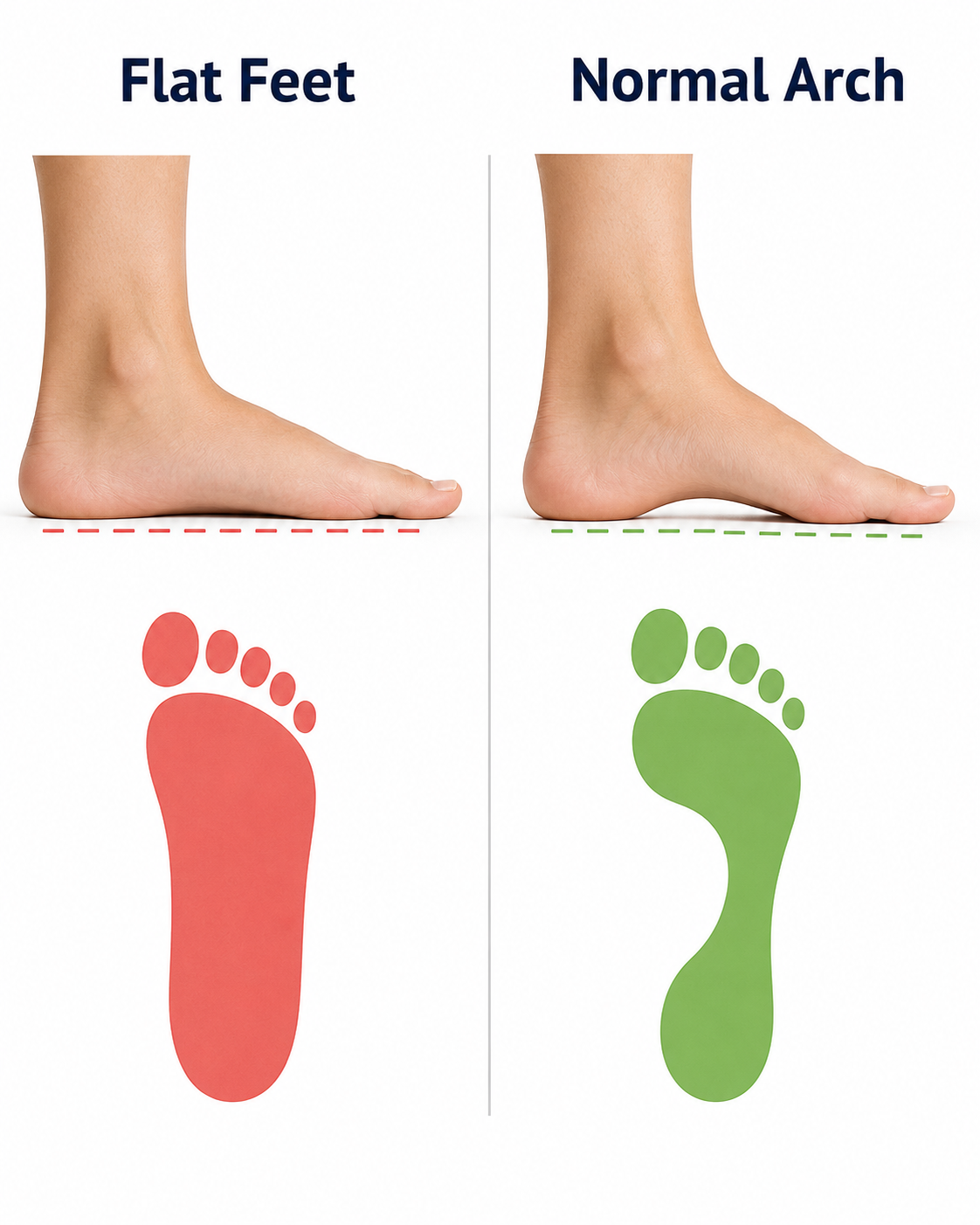
Flat feet, also called pes planus, or kaki rata / tapak kaki rata in Bahasa Malaysia means the arch of your foot is lower than usual, or absent altogether when you stand. Instead of the inner edge of your foot lifting off the ground, your entire sole makes contact.
There are two types worth knowing:
Flexible flat feet. The arch appears when your foot is lifted off the ground but disappears when you stand. This is the most common type. It's usually painless in children and may or may not cause problems in adults.
Rigid flat feet. The arch is absent whether you're standing or not. This is less common and more likely to cause pain and functional problems. It often has an underlying structural or bone-related cause.
Most people with flat feet have the flexible kind and many never experience any problems at all. But that doesn't mean flat feet should always be dismissed.
Are Flat Feet Common in Malaysia?
Very. Flat feet are more prevalent in Asian populations than global averages and Malaysia's footwear culture makes things worse. Years of wearing flip-flops and flat sandals, walking barefoot indoors on hard tiled floors, and limited time in supportive enclosed shoes all reduce the natural strengthening of the foot's arch muscles over time.
Genetics plays a role too. If one or both parents have flat feet, there's a higher likelihood their children will too. Pregnancy, weight gain, ageing, and injury can also cause arches to flatten in adulthood even in people who had normal arches for most of their lives.
A simple home check: the wet footprint test
Wet the bottom of your foot and step onto a piece of cardboard or dark paper. Look at the imprint:
A normal arch leaves a visible curve on the inner edge - you can see roughly half the foot
A flat foot leaves a near-complete footprint with little or no inward curve
A very high arch (also worth knowing about) leaves only a thin strip or two separate islands
This test gives you a rough idea but it doesn't tell you whether your flat feet are affecting how you walk, which is what actually matters clinically.
A Word on Barefoot Shoes
Many parents and adults with flat feet have encountered barefoot shoe content online. The idea being that minimalist, thin-soled shoes "retrain" the foot and rebuild the arch. It's an appealing claim, and wide toe boxes do offer genuine benefits for foot shape.
But here's the honest clinical view: barefoot shoes are not a treatment for flat feet. They may help some people with healthy, strong feet who transition carefully. But if your flat feet are already causing pain in the heel, arch, knee, or lower back - switching to barefoot shoes without a biomechanical assessment first is likely to make things worse, not better. The foot needs support while the underlying biomechanics are being addressed, not less support while it's already under strain.
If you're curious whether barefoot shoes are right for your feet, that's exactly what a podiatric assessment is for.
Flat Feet in Children - When to Worry, When to Wait
Most toddlers appear flat-footed. That's normal. A child's arch typically develops gradually between ages 3 and 10 as the muscles, tendons, and ligaments mature. A two year old with flat feet is almost always a healthy two year old, not a patient.
When flat feet in children are likely fine:
Both feet look similar
Your child is active, walks and runs without pain, and doesn't trip more than other children
They're under 8 years old and haven't shown any of the warning signs below
When to get it checked:
Pain or tenderness in the heel, arch, or ankle - especially after activity
One foot is noticeably flatter than the other (asymmetry is a red flag)
Your child frequently trips, stumbles, or avoids physical activity
They walk on the outer edge of the foot or the feet are always turned inward or outward
Calves or feet feel very tight or stiff in the morning
The flat feet persist past age 8–10 with no arch developing
If any of these apply, a podiatric assessment - not a "wait and see" approach is the right call. Catching issues early means simpler interventions and less impact on a growing child's posture, knees, and hips.
Flat Feet in Adults - Why They Cause Pain Over Time
If your flat feet are not causing any pain or limiting what you do, you may not need treatment at all. But if they are causing problems, even problems you've normalised as "just the way my feet are". They are worth addressing.
In adults, flat feet can contribute to:
Heel pain and arch pain. The plantar fascia (the band of tissue along the underside of your foot) works harder to compensate, leading to plantar fasciitis
Knee pain. Flat feet cause the ankle to roll inward (overpronation / berlipat ke dalam), which rotates the shin and places uneven stress on the knee joint
Hip and lower back pain. The same inward rolling shifts the pelvis, putting strain on the hips and lumbar spine
Bunions. The inward pressure on the big toe joint from flat feet accelerates bunion formation
Shin splints. The leg muscles work harder to compensate for poor foot mechanics
The longer flat feet go unaddressed in adults, the more secondary problems develop up the chain. What starts as mild arch discomfort can become persistent knee pain or lower back issues if the underlying gait problem isn't corrected.
Visit our Plantar Fasciitis, Bunions, Patellofemoral Pain Syndrome and Shin Splints pages if any of these conditions sound familiar.
How a Podiatrist Diagnoses and Treats Flat Feet
A podiatric assessment for flat feet is not about looking at your foot in isolation. It's about understanding how your whole body moves.
At KL Foot Specialist Podiatry, a biomechanical assessment typically includes:
Gait analysis - watching how you walk, where your foot lands, how your ankle rolls, and what compensations your body has developed
3D foot scanning - capturing the precise shape of your arch and the pressure distribution across your sole
Muscle and joint testing - checking calf tightness, ankle flexibility, and hip strength, all of which influence how your flat foot behaves
Based on this, your podiatrist will design a treatment plan. For flat feet, this commonly includes:
Custom orthotics - prescription devices made from your 3D scan, designed to support your arch and correct the inward rolling of the ankle. Unlike generic insoles from pharmacies or online stores, custom orthotics are built around your specific foot shape, gait pattern, and the condition being treated. They address the root cause, not just the symptom.
Targeted exercises - strengthening the muscles that support the arch (the intrinsic foot muscles, calf, and hip stabilisers). Exercises alone won't restructure a foot that has a structural cause, but they're an important part of management.
Footwear advice - guidance on what to look for in daily shoes, work shoes, and exercise footwear. Not a prescription to stop wearing the shoes you love but a practical plan to balance support with what you actually wear.
Do Flat Feet Need Custom Orthotics?
Not always. Here's the honest answer:
Custom orthotics are recommended when flat feet are causing pain, affecting your gait, or contributing to secondary problems in the knee, hip, or lower back. They're also recommended when generic insoles haven't helped because an off-the-shelf insole provides cushioning, not biomechanical correction.
For children, orthotics are used more selectively. A child who has flat feet but no pain, no asymmetry, and no gait issues typically doesn't need orthotics. When they are prescribed for a child, they need to be monitored and replaced regularly as the foot grows.
For adults with structural flat feet that are causing consistent pain - particularly plantar fasciitis, knee pain, or lower back pain. Custom orthotics are often the most effective long-term solution. Not because they're the most expensive option, but because they're the only option designed specifically for how your foot moves.
Explore our Custom Orthotics service for more on what the process involves.
When Should You See a Podiatrist About Flat Feet?
Come in if:
Your child complains of foot or heel pain after activity, or shows any of the warning signs listed above
Your flat feet are causing pain that's affecting your daily routine at work, during exercise, or first thing in the morning
You've tried pharmacy insoles and they've given you little or no relief
Your knee, hip, or lower back pain has been linked to your gait or foot position by another health professional
You've been told you have flat feet and you want to understand whether it's something to address or not
A podiatric assessment will give you a clear answer and a plan if one is needed. You don't need a referral from a doctor to book.
Not sure if what you're experiencing needs attention? WhatsApp us at +60126937216 and we will help you figure it out.
Ready to take the first step? Book a consultation with KL Foot Specialist Podiatry in Sri Petaling, KL.
-
Yes. Most toddlers appear flat-footed, and that's completely normal. The arch develops gradually as the foot's muscles, tendons, and ligaments mature, usually becoming visible between ages 3 and 10. A young child with flat feet is not automatically a child who needs treatment. The time to get it checked is if your child has foot or heel pain, trips frequently, has one foot much flatter than the other, or the flat feet persist past age 8–10 without any arch developing.
-
Flat feet refers to the structure of the foot - the arch is low or absent when standing. Overpronation (berlipat ke dalam) is a movement pattern - where the ankle rolls inward excessively when walking or running. Many people with flat feet also overpronate, because a low arch reduces the foot's ability to control that inward roll. But the two don't always go together: you can have flat feet without significant overpronation, or overpronate with a normal-looking arch. A biomechanical assessment looks at both.
-
Yes, and it's one of the most commonly overlooked connections. When the foot overpronates due to flat arches, the shin rotates inward, which places uneven stress on the knee joint. Over time this can cause pain at the front of the knee, around the kneecap, or along the inner knee. If you've been told your knee pain is "just wear and tear" but nobody has looked at how your feet move, it may be worth a podiatric assessment.
-
Genetics plays a significant role. Flat feet often run in families, and if one or both parents have flat feet, their children are more likely to as well. That said, flat feet can also develop in adulthood in people who previously had normal arches, due to weight gain, pregnancy, injury, or simply the gradual effects of years in unsupportive footwear. Malaysia's flat sandal and flip-flop culture is a contributing factor many people don't realise.
-
Pharmacy insoles (tapak kasut kedai ubat) are mass-produced for a generic foot shape. They can add cushioning and a basic degree of arch support, but they're not designed around your specific foot shape, arch height, or gait pattern. Custom orthotics are made from a 3D scan of your foot and prescribed based on a full biomechanical assessment. They are built to correct the specific way your foot moves, not just pad it. For mild discomfort, pharmacy insoles may be enough. For persistent pain or conditions linked to your gait, custom orthotics address the root cause rather than masking the symptom.
-
No. You can book directly at KL Foot Specialist Podiatry in Sri Petaling, KL without a referral from a GP, orthopaedic surgeon, or any other doctor. If after your assessment we identify something that requires referral elsewhere (for example, a structural bone issue that warrants imaging), we'll let you know and guide you to the right place.
-
This varies by person. Most adults start noticing reduced pain within 4–8 weeks of consistent orthotics use, as the foot and lower limb gradually adapt to the corrected alignment. For children, improvements in gait and pain levels are often seen sooner. Orthotics are not a one-time fix. A follow-up assessment is important to check fit, make adjustments, and monitor progress, particularly for growing children.